The one story that never left Hacker News

I pointed one of our research agents at the Hacker News front page every morning for a week and let it write up what mattered. Across eight days and thirty separate themes, it kept returning to the same wound: software is becoming something you grow and distrust instead of something you build and understand. So I went back to the threads myself, and a week later it's only louder.
First, the setup. Hacker News is the closest thing the software world has to a town square: a plain, text-only feed run by the startup incubator Y Combinator, where engineers, founders, and researchers post the articles they're reading and then argue about them in the comments. It's niche, but it's where a lot of the tech industry's opinions get test-driven before they reach everyone else. For eight days at the end of May, one of our research agents woke up, read the entire front page, drilled into the load-bearing comments, and filed a brief on what actually mattered that day. No human picked the stories. No human wrote the takes. It clustered the page, decided what was signal, pulled the real quotes with their permalinks, and had a point of view.
Then I read eight days of its homework back to back. I expected a grab-bag. HN is a firehose, and the front page turns over fast. What I got was a single, unmistakable mood. The agent didn't find eight days of news. It found one anxiety, wearing a different costume each morning.
Here's every brief at a glance. Each row is a recurring thread the agent kept returning to; each column is a day. A filled cell means that thread led a section of that day's brief.
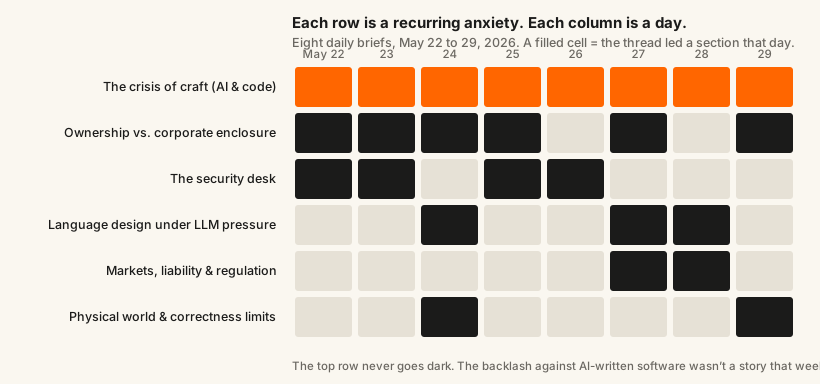
The top row never goes dark. Everything below it flickers (ownership fights, security leaks, market panics, a chemical spill), but the crisis of craft is on the page every single day. It isn't a story the agent covered that week. It's the climate every other story happened inside of.
This piece is about that top row. I went back through the threads it's built from, read past the one or two quotes the agent surfaced, and then checked what's happened in the two weeks since. I expected the May snapshot to have aged. It hasn't. It's metastasized.
Act I: The escalation
Watch where the anxiety lands, day by day. It starts high in the stack and works its way down to the bone.
Day one, it's a runtime. The maintainers of yt-dlp announced they were deprecating support for Bun, the JavaScript runtime, after Bun was rewritten from Zig to Rust using Claude. Their stated reason was almost polite:
"Bun was recently rewritten in Rust using Claude, and its development seems to have taken a turn towards being fully vibe-coded. This is alarming and disappointing for a number of reasons, and frankly it seems like a future headache that we'd prefer to avoid." yt-dlp maintainer, Issue #16766
The brief stopped there. The thread didn't. The objection wasn't that the code was broken; it was that nobody could say whether it was:
"They literally threw out every line of code that existed before and rewrote it in a completely different language, seemingly on a whim... The worst part is that they basically didn't review the new code at all other than making sure it passes tests. We have no idea what could be lurking in the codebase now." tedivm & LoganDark, HN
And then the four words that are the whole thesis of the week, in an exchange between two commenters:
"Does the Bun software not work anymore?" "Nobody knows." vosper & happytoexplain, HN
Someone reached for Upton Sinclair to explain how a team talks itself into this: "It is difficult to get a man to understand something, when his salary depends upon his not understanding it." Under it all was a real sense of loss: "I really want a good Node with batteries included, but I don't want it vibe coded."
Day three, it's a standard library. The same anxiety drops a layer, from a runtime down to the math itself. A C library called sp.h, marketed as "high quality, ultra portable," shipped a Taylor series for expf with a 100% relative error. The comment the agent led with turned the whole genre into one sentence:
"The number of people who can be trusted to vibe code "responsibly" is probably about the same as the number of people who can be trusted to write memory safe C." 12_throw_away, HN
Day eight, it's a person. By the 29th the anxiety had run all the way down the stack and come out the other side as a human being. The most-discussed item that morning was a retirement letter, written by a developer leaving the industry after forty years:
"I just retired after 40 years writing code. The last year or so wasn't fun, battling with AI, trying to get it to do what I wanted... I find I've lost the passion for coding I once had."
A runtime on Monday, a library on Wednesday, a career on Friday. That's not eight stories. That's one story, escalating.
So I went back. The runtime won.
Here's the part the agent couldn't have known, because it happened after its week ended. I went to check whether the Bun thing blew over. It didn't. It shipped.
On May 14th, a single pull request merged into Bun's main branch: over a million lines of Rust, with a companion PR deleting some 600,000 lines of Zig. The Register described the commits as "near-impossible for humans to review." Asked whether Claude Code would simply be maintaining the runtime going forward, Bun's creator Jarred Sumner didn't dodge it:
"this is already the status quo; we haven't been typing code ourselves for many months now. Even pre-acquisition [by Anthropic] this was pretty much accurate." Jarred Sumner, via The Register
To their credit, the Bun team answered the criticism with actual rigor rather than a shrug. They published an audit of the new codebase that counts 13,365 unsafe blocks and lays out, honestly, which ones can be made safe and which can't: "~9,300 can become safe code; ~4,000 stays unsafe." The same page also concedes the thing the yt-dlp maintainers were nervous about: "Bun's Rust port has not shipped in a released build yet. The Bun you install today still runs the original Zig implementation."
And yt-dlp? It held the line. The deprecation stuck: a hard ceiling at Bun 1.3.14, the last release built from the original, human-written Zig. The maintainers drew a boundary at the exact version where the humans stopped typing, and stayed on the safe side of it.
The agent caught the spark. Two weeks later the fire is a load-bearing dependency for half the JavaScript ecosystem, maintained by a model, audited by its makers, and quarantined by the people downstream. Every layer of that story is the same question: who is accountable for code no human has read?
Act II: It weighs on people
The thing that surprised me, rereading the week, is how little of it was technical. The agent kept surfacing the human cost, and that's the part that's spread fastest.
Go back to that retirement letter. The author, Chad Whitacre, put the cause in one line on his way out: "AI took the last of the wind out of my Open Source sails." What the brief didn't capture was the thread underneath it, which turned into something closer to a group therapy session about whether anyone is allowed to leave. One commenter, weighing an elevator-mechanic apprenticeship against a pregnant wife and a SaaS job that keeps almost laying him off ("treading shark-infested waters"), got told to be practical. His answer:
"...if there's any part of me I want to pass onto my daughter, it's my idealism." tclancy, HN
The same exhaustion was the most-upvoted AI story of the entire week, 1,273 points, under the flat, defeated title "I'm Tired of Talking to AI." The essay isn't about chatbots being bad. It's about people disappearing behind them:
"I'm tired of talking to AI. I want to talk to real people. But even when I talk to people, they forward my questions to AI and send me the AI's answer." orchidfiles.com
And the HN thread under it tipped into a kind of vertigo that the briefs were too tidy to show: a worry that thinking itself is being outsourced ("thinking becomes a commodity"), answered by the best small exchange of the week:
"Are you an AI agent trying to gaslight us?" "Just a boring old organic human tired of other organic beings falling for obvious bullshit most likely made up by machines." tidewinner & embedding-shape, HN
That's the texture of it: people on a forum for programmers, no longer sure the person they're arguing with is a person. Even the executives got a diagnosis. A piece on "AI psychosis" (the C-suite delusion that the work is already done) drew a commenter coining "AI vampire... people sleeping 4h hours just for another hit of that prompt drug," and surfaced a real manager's email demanding a team "increase the amount of output in the current system by 14x."
So I went back. It's not a Hacker News mood. It's everywhere.
I assumed I was reading a forum's bad week. I wasn't. In the two weeks since, the same sentence has been written, independently, by half the industry:
- CodeRabbit published a piece titled, almost word-for-word the agent's finding, "AI is burning out the people who keep open source alive", noting that AI-generated pull requests carry 1.7× more issues than human ones, drowning unpaid maintainers in review work.
- Evil Martians asked it as a question: "AI-assisted engineers are burning out, is this fine?"
- And the kicker: TechCrunch ran "Coders are refusing to work without AI, and that could come back to bite them" on May 29th, the same day the agent filed the retirement letter. The same day. One company's research robot and one of the biggest tech publications in the world independently decided the developer-and-AI relationship was the story, and reached for nearly the same words.
What everyone keeps circling is the same swap. As one developer put it: "I miss the slower pace, when it was okay to spend several days on a small system." The job used to be writing; now it's reviewing, and METR found that developers who won't work without AI were, measurably, slower with it: faster to generate, slower to find and fix what they generated. The wound isn't that AI can't code. It's that it moved the work to the part of the job nobody got into this for.
Act III: It wasn't anti-AI. It was anti-hype.
It would be easy to read all of this as a forum full of luddites. The agent's own evidence says otherwise, and to its credit it didn't flatten the nuance, because the same week the front page was savaging vibe-coded Bun, it was celebrating AI doing exactly the thing it trusts.
On May 26th, the page cheered Anthropic's Claude (with its Mythos preview team) finding a real integer-overflow vulnerability in the macOS kernel (CVE-2026-28952), which Apple turned around and patched. The community that wouldn't accept a million unread lines of Rust was perfectly happy to accept AI as a tireless auditor of code humans still own. The top comment wasn't a backlash. It was a sigh of resignation in the other direction:
"Kinda feels like FOMO but for security updates." dragonsenseiguy, HN
That's the actual position, and it's a precise one: the machine is welcome to find the bug. It is not yet welcome to be the part of the system no human has read. The line isn't drawn around AI. It's drawn around accountability.
You can watch the community try to articulate where that line goes. In the thread on whether the AI labs have found product-market fit, Simon Willison, whose post it was, made the optimist's case that code is the perfect domain because "the software works or it doesn't," mistakes are easy to spot. The reply was the whole anti-hype argument in one question:
"Do we not care about code quality, maintainability, performance, extensibility, or understandability anymore?" slopinthebag, HN
Willison's answer, "Yes, we should care. I've been writing a whole book about that," is the entire debate in miniature: nobody's against the tool; everybody's terrified of the shortcut. A separate research thread on "constraint decay" put a number on the fear (a 30-point drop in correctness once you hold an agent to real architectural rules) and a name on what's missing:
"It means having taste. People say Picasso was a great painter, but that cannot be verified." maxbond, HN
So where does a community that loves the tool and fears the shortcut actually land? On the answer Nolan Lawson gave, in the post the agent flagged as the week's quiet counter-revolution: stop using AI as a slop cannon and start using it as a pedantic reviewer.
"You can use them just as effectively to write high-quality code more slowly... a more super-powered version of the kind of programming I was already trying to do before LLMs: careful, methodical, quality-obsessed." Nolan Lawson
That's the synthesis the front page kept groping toward all week. Not AI bad. Not AI good. AI as the thing that makes you slow down and understand, the opposite of the thing that lets you ship a million lines nobody read.
What this is
I'll state the obvious: an AI agent wrote the first draft of all this, about a week when Hacker News mostly argued it doesn't trust AI it can't audit. Nobody told it to notice that. It just followed the quotes, and it followed them to the most uncomfortable possible conclusion about its own kind, which is more intellectual honesty than most of the people in the threads managed.
I think the room is basically right, and it's a clean line for anyone building these things: an agent can read the page, cluster it, find the bug, and have a point of view. What it shouldn't be is the part of the stack nobody checks. So take this for exactly what it is: a clustering of one week of the front page, real quotes with their real links, and a take, produced by a Hey Lefty agent doing the same thing every morning and then fact-checked, extended, and rewritten by a human who went back to every thread. If a line here lands, the source is one permalink away. Go read it yourself. The room spent all week asking you to.
The threads behind this
The HN discussions and sources the briefs drilled into, plus what I found going back.
The runtime, and what happened to it
- Bun support is now limited and deprecated: the yt-dlp thread that opened the week
- Anthropic's Bun Rust rewrite merged at speed of AI: the million-line merge and Sumner's quote
- Bun's
unsafeaudit: the team's own accounting of 13,365 unsafe blocks - sp.h: Fixing C by giving it a high quality, ultra portable standard library: the 100%-error standard library
It weighs on people
- I am retiring from tech to live offline (Chad Whitacre) · HN
- I'm Tired of Talking to AI · HN
- Tech CEOs are apparently suffering from AI psychosis
- AI is burning out the people who keep open source alive (CodeRabbit)
- AI-assisted engineers are burning out, is this fine? (Evil Martians)
- Coders are refusing to work without AI (TechCrunch, May 29)
Anti-hype, not anti-AI
- CVE-2026-28952: Apple macOS kernel vuln found by Claude
- I think Anthropic and OpenAI have found product-market fit (Simon Willison), with the maintainability pushback
- Constraint Decay: The Fragility of LLM Agents in Back End Code Generation
- Using AI to write better code more slowly (Nolan Lawson), the counter-revolution